VHS Video Cassette Guide: How Tapes and Decks Work
A VHS video cassette is a plastic shell holding half-inch magnetic videotape, designed to be played in a VCR (video cassette recorder) that reads the tape with a spinning head drum. Introduced by JVC in the 1970s, the format dominated home video for two decades and still turns up in family archives, local broadcast libraries, and business records that need to be digitized.
This guide covers how the tape and the deck work together, the physical dimensions and tape lengths, the format's history, how to store tapes safely, and what to watch for when a deck starts to fail.
How a VHS Video Cassette Is Built
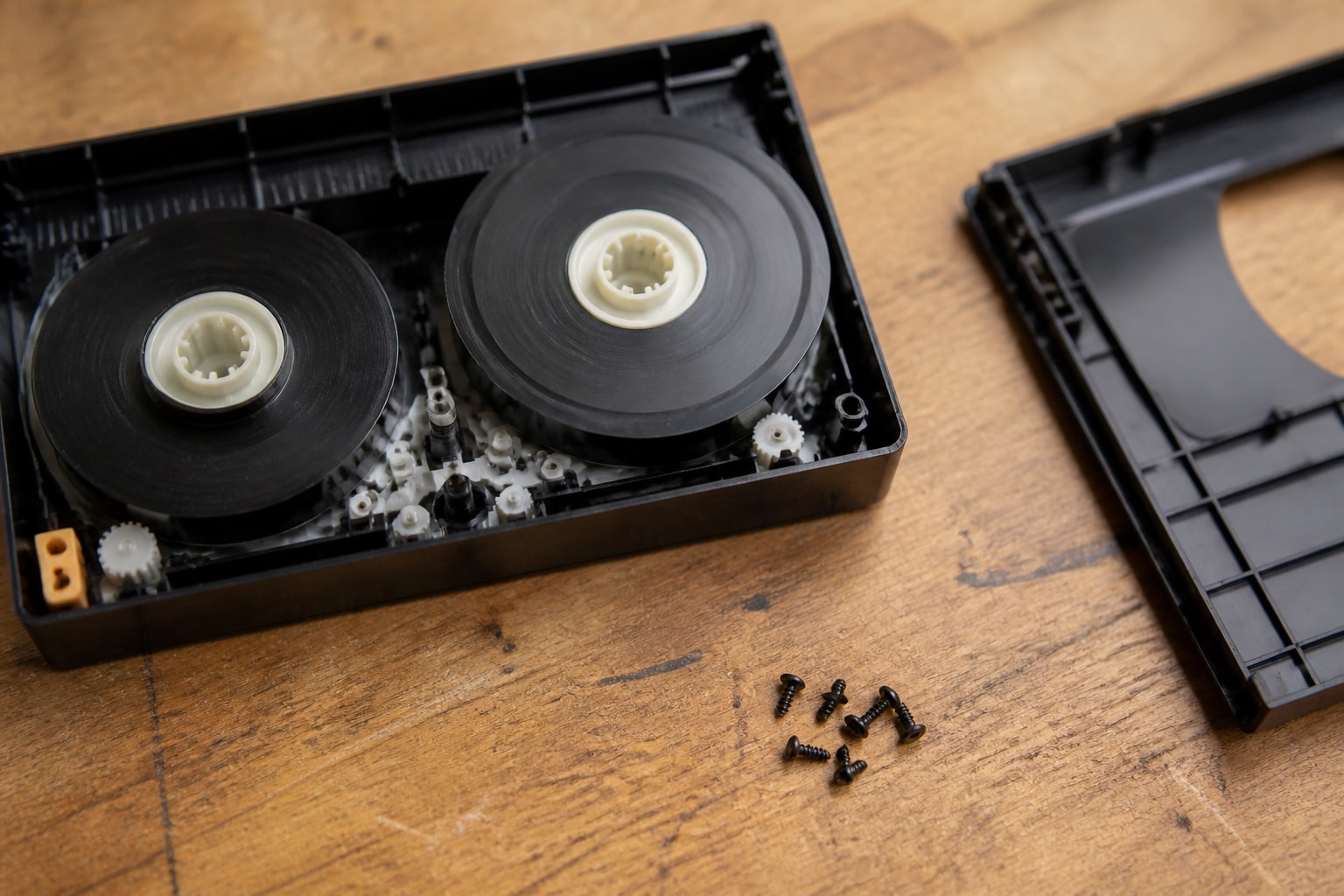
A VHS cassette contains a single length of 0.5-inch (12.7 mm) magnetic tape wound between two spools inside a rigid plastic shell, according to the VHS overview on Wikipedia. The shell protects the tape from dust and fingerprints and holds every moving part needed to feed it into a deck.
The main components are:
- Supply and take-up reels: Two hubs that hold the tape. The deck turns them in opposite directions to move the tape forward, rewind it, or fast-forward.
- Tape guides: Small posts that keep the tape aligned as it exits the shell.
- Front flap: A hinged lid that covers the exposed tape. The deck opens it during loading.
- Record-protect tab: A small plastic tab on the rear edge. Breaking it out prevents accidental recording over the tape.
- Brake and lock mechanism: Stops the reels from spinning when the cassette is out of the deck, which prevents loose, tangled tape.
The tape itself has a polyester base coated with magnetic particles. Over time, the binder that holds those particles can break down, which is one reason older tapes shed oxide or squeal during playback.
What Are the Dimensions of a VHS Tape?
A standard VHS cassette has a fixed shell footprint that stays the same regardless of how many hours of tape it holds. The exact dimensions are not covered in the sources used for this guide.
Tape length varies by the cassette's rated runtime. A typical T-120 cassette holds 247.5 meters (812 feet) of tape, per the VHS overview. The shorter and longer variants fit inside the same shell, so the tape thickness changes instead of the cassette size.
| Cassette type | Approx. runtime (standard play, NTSC) | Notes |
|---|---|---|
| T-30 | Short runtime | Common for short camera recordings |
| T-60 | Medium runtime | Thinner stock than a T-30 per minute |
| T-120 | Longer runtime | The most common retail length |
| T-160 | Longest runtime | Thinner tape, more prone to stretching |
Two other points matter for anyone handling mixed collections:
- VHS-C cassettes are a compact version used in camcorders. They hold less tape and need an adapter shell to play in a standard deck. You can read more about handling them in our guide to repairing VHS-C tape.
- S-VHS cassettes look nearly identical to standard VHS but use a higher-coercivity tape that supports a sharper picture. Standard decks cannot play S-VHS recordings in full quality, and a dedicated S-VHS format deck is needed.
How a VHS Deck Reads the Tape
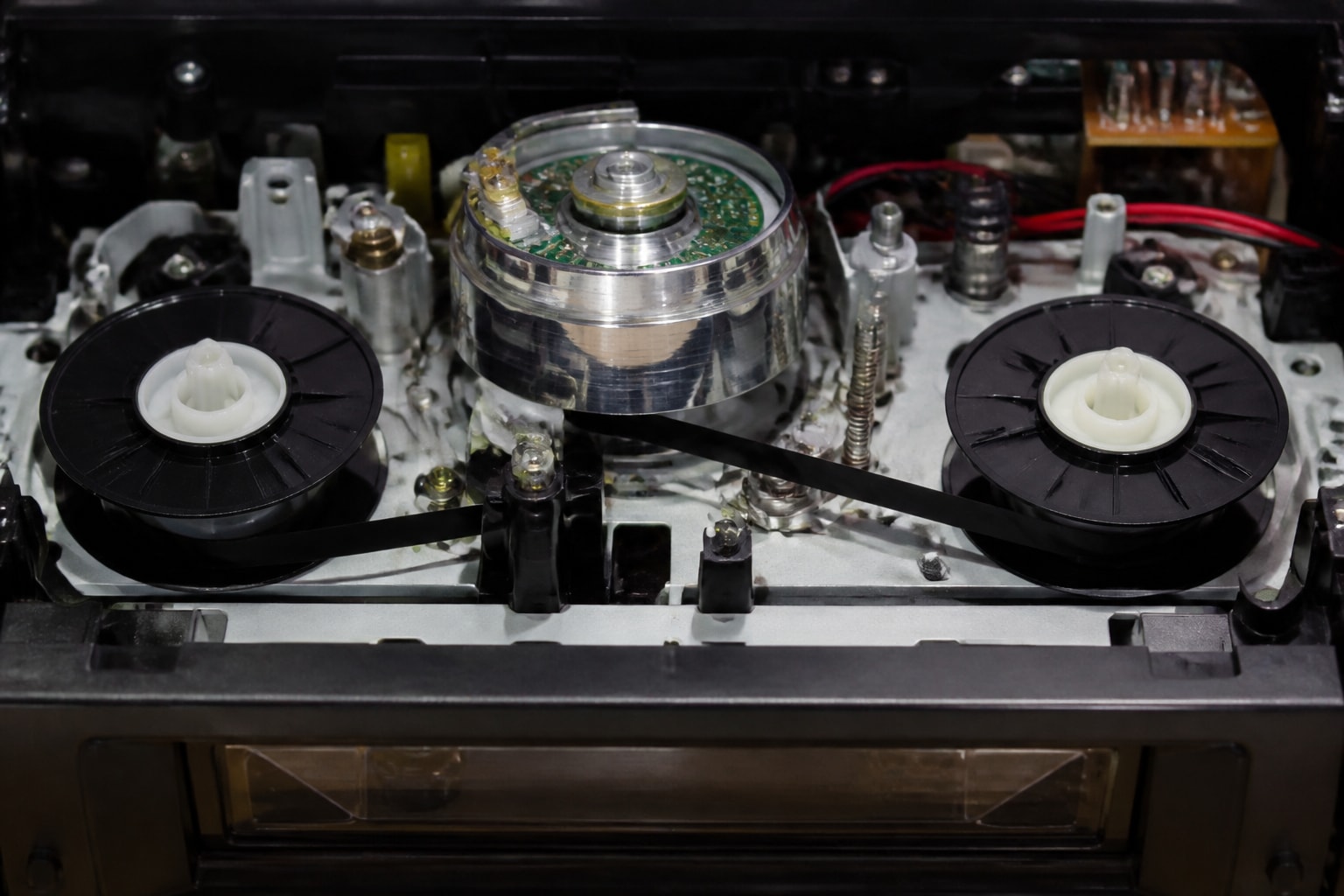
Slanting the tracks lets the format store a large amount of video signal on slow-moving tape.
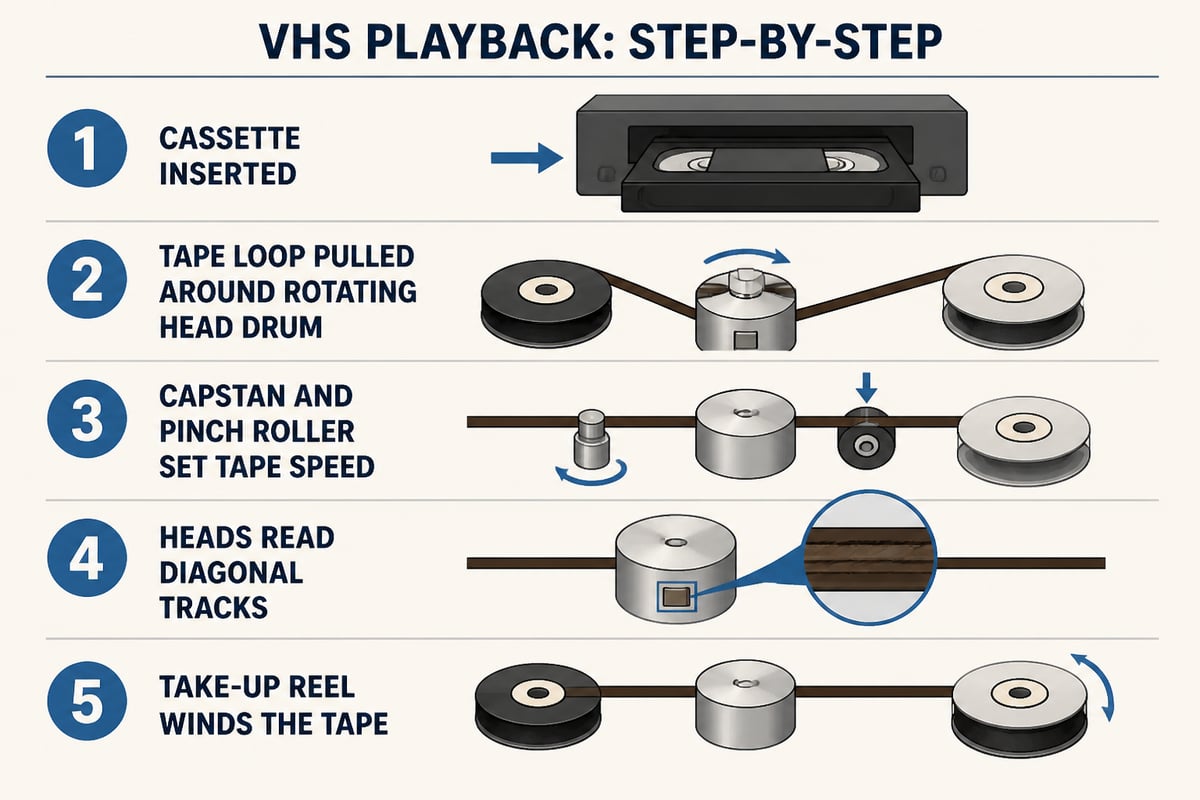
The loading sequence in a typical deck runs like this:
- The deck's loading motor pulls the cassette into the carriage and lowers it onto the spindles.
- Guide arms pull a loop of tape out of the shell and wrap it around the head drum.
- The capstan, a thin metal shaft, and the pinch roller grip the tape and pull it at a steady speed.
- The spinning heads read the diagonal video tracks, while stationary heads handle linear audio and control tracks.
- Tension sensors and brakes keep the tape taut so the picture stays locked.
In NTSC standard-play mode, the tape moves at 1.313 inches per second, while PAL standard play runs slower at 0.921 inches per second (VHS overview). Slower speeds such as long play and extended play stretch recording time but reduce quality, and they put more strain on the head-to-tape contact.
Why Alignment and Wear Matter
The head drum, capstan, and guide posts must sit within tight tolerances. A worn pinch roller or a misaligned guide can cause tracking errors, horizontal noise bars, or audio dropouts. Decks used daily in a digitization workflow wear faster than a household VCR, so preventive service matters. Our overview of VHS repair covers the common mechanical faults.
When Was VHS Popular?
VHS was most popular from the early 1980s through the late 1990s, after it won the home video format competition against Betamax. It remained the default way to watch rented movies and record television until DVD overtook it in the early 2000s.
A rough timeline helps frame the format's life:
- Late 1970s: JVC introduces VHS, and it begins competing with Betamax.
- Late 1970s to early 1980s: VHS and Betamax compete, and VHS gains market share thanks to longer recording times and wider licensing.
- Mid 1980s: Video rental stores spread, and VHS becomes the dominant format in most markets.
- Late 1990s to early 2000s: DVD begins replacing VHS for pre-recorded movies, and home recording shifts toward DVD recorders and later digital video recorders.
For a closer comparison of the two rival formats, see our breakdown of VHS and Betamax.
What Is the Difference Between VHS and a Cassette Tape?
A VHS tape records video and audio on half-inch tape using rotating heads, while an audio cassette records sound only, on a narrower tape that runs past stationary heads. Both are magnetic media in plastic shells, but they are not interchangeable.
Key differences:
- Content: VHS stores moving pictures plus sound. Audio cassettes store sound only.
- Tape width: VHS uses 0.5-inch tape. A compact audio cassette uses roughly 0.15-inch tape.
- Head design: VHS uses a spinning head drum for diagonal tracks. Audio cassettes use fixed heads and linear tracks.
- Size: A VHS cassette is far larger than a compact audio cassette.
- Playback hardware: VHS needs a VCR with a video output. Audio cassettes play on a tape deck or a Walkman.
Professionals also work with other tape families, such as MiniDV cassettes and Digital8, which store digital video rather than the analog signal VHS uses.

Are Blank VHS Tapes Still Made?
New blank VHS tapes are no longer made by the major manufacturers in any significant volume, and most blank stock sold today is leftover inventory, resale, or small-batch production. Availability is inconsistent, quality varies, and old stock can be decades past its best condition.
For anyone planning to record new material, that has practical consequences. Unopened old stock may have degraded binder, and used tapes may carry wear from earlier recordings. For archival work, most shops now treat VHS as a source format to be transferred out of, not a destination to record into. The goal is to move content to a stable digital file and keep the original tape as a backup.
How to Store a VHS Video Cassette So It Lasts
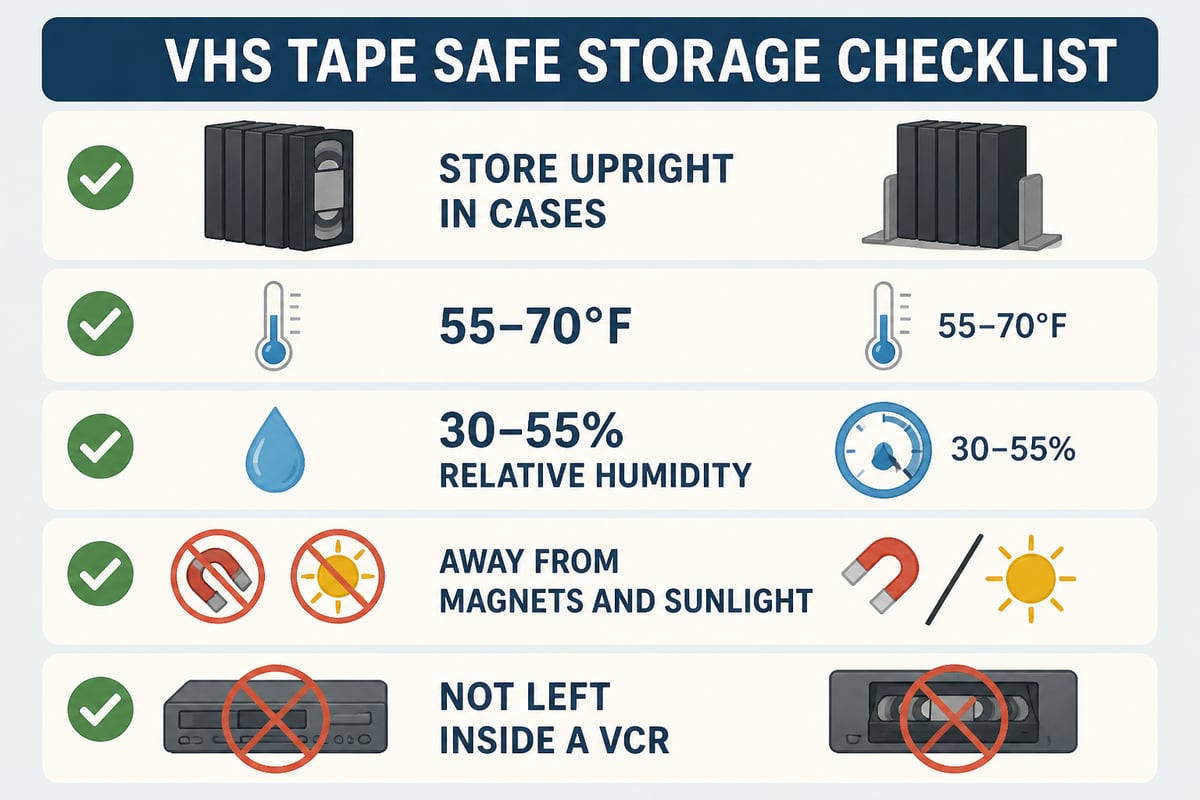
The best way to store a VHS video cassette is upright in its case, in a cool, dry room with steady temperature and humidity, away from magnets and sunlight. Good storage slows the chemical and mechanical aging that makes tapes unplayable.
The National Archives recommends a stable home environment of 55 to 70°F and 30 to 55% relative humidity, and advises storing videotapes vertically in their boxes, away from magnetic fields, and not leaving them inside a VCR when not in use (National Archives video storage guidance). For magnetic tape in long-term holdings, the agency recommends 50 to 65°F and 30 to 40% relative humidity, and notes that humidity above 65% can contribute to mold growth (National Archives machine-readable media guidance).
A short storage checklist:
- Store tapes on edge, never flat in tall stacks.
- Keep them out of attics, basements, garages, and cars.
- Rewind or fast-forward fully before long-term storage to even out tape pack tension.
- Keep tapes away from speakers, motors, and other magnetic sources.
- Handle the cassette by its shell, never by touching exposed tape.
The Library of Congress also publishes practical handling and storage advice for audio-visual materials.
Common VHS Tape and Deck Problems
Most VHS playback failures come from either the tape (mold, sticky binder, stretched or creased tape) or the deck (dirty heads, worn rollers, failing belts). Telling them apart prevents damage to good equipment.
Tape-side problems
- Mold or mildew: White or gray fuzz on the tape edge or reels. Do not play moldy tape in a good deck, since spores and debris transfer to the heads.
- Sticky-shed or binder breakdown: The tape squeals or leaves residue on the heads.
- Stretched or creased tape: Causes wavy pictures and tracking loss.
- Broken shell or pulled tape: Needs a careful transfer into a new shell before any playback.
The Library of Congress advises against playing damaged tape, because playback can further harm both the media and the playback equipment (Library of Congress A/V preservation FAQ).
Deck-side problems
- Eating tapes: Often a worn pinch roller, weak take-up torque, or a failing loading mechanism.
- Snowy or noisy picture: Dirty or worn video heads.
- No power or no loading: Failed belts, gears, or a power supply fault.
- Audio dropouts or warble: Capstan or tension issues.
If a deck is showing these faults, a diagnosis will separate a simple cleaning from a mechanical repair.
Why Tape Condition and Deck Quality Both Affect Digitization
A clean transfer depends on a healthy tape and a well-maintained deck, and neither can compensate for the other. A perfect tape played on a worn deck produces noise and instability, and a perfect deck cannot recover signal from badly degraded tape.
For digitization shops, three practical points follow:
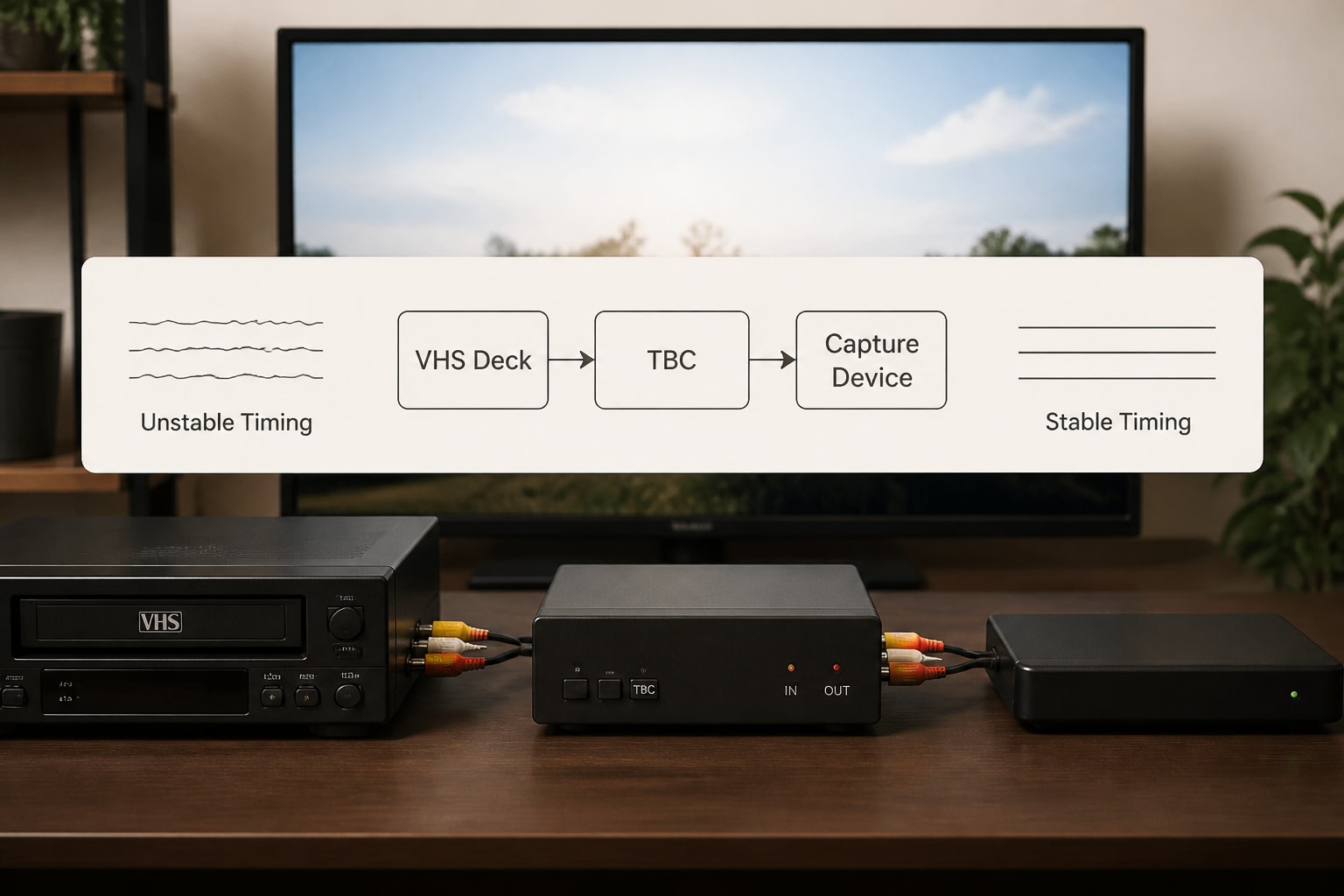
- Use a deck matched to the format. S-VHS recordings need an S-VHS deck for full resolution, and a time base corrector (TBC) stabilizes the signal before capture.
- Inspect every tape before playback. A quick look at the shell, reels, and tape edge catches mold and damage before it reaches the heads.
- Separate preservation copies from access copies. The National Archives explains this distinction in its video playback and digitization guidance: a preservation copy captures the highest quality source, while an access copy is a smaller file made for convenient viewing.
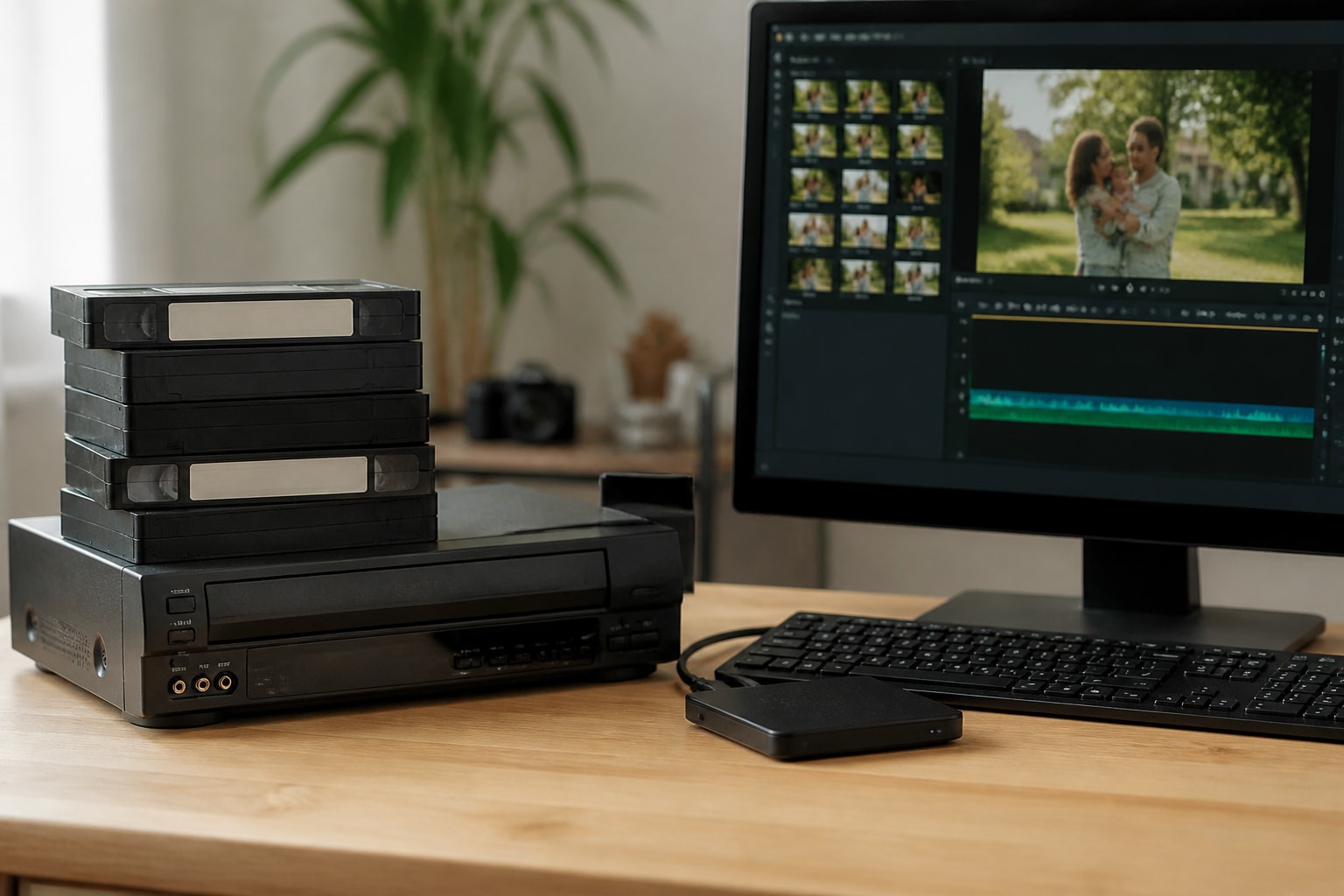
Shops that run large batches also need spare decks and a plan for downtime. Renting professional decks and signing a maintenance contract keeps a project moving when a primary machine goes down, and our notes on machines for transferring VHS to DVD cover the capture side of the workflow. Families who would rather hand the job off can also look for a full-service transfer provider experienced with older home-movie formats.
FAQ
Can a VHS tape be played in any VCR?
Standard VHS tapes play in any working VHS deck, but NTSC and PAL tapes are not cross-compatible without a multi-standard deck. S-VHS recordings require an S-VHS deck for full quality, and VHS-C needs an adapter cassette.
How long does a VHS tape last?
With good storage, many tapes remain playable for several decades, but condition varies widely. Heat, humidity, repeated playback, and binder breakdown shorten life, which is why tapes of value should be transferred to digital sooner rather than later.
Should I clean a VHS tape before playing it?
Only inspect it visually and play it if it looks clean. Tapes showing mold, sticky residue, or a damaged shell should go to a technician, since playing them can contaminate the heads and harm the tape further.
Start by pulling your most important tapes, checking each shell and tape edge for mold or damage, and sorting them by format so you know which decks you need. If you run a digitization shop and need dependable equipment, VCR Supply rents and repairs professional videotape decks, including MiniDV, S-VHS, Digital8, and Betamax. Rentals start at $99 per month, repairs carry a $45 diagnostic fee, and maintenance contracts help reduce downtime on active projects.